Learning music helps with a child’s brain development. But did you know it also helps to improve maths skills? To play a musical instrument well, you need to develop your critical thinking and problem solving skills. These are key skills when learning maths. If you think back to early childhood, young children often learn counting through rhythm. They first start clapping their hands and bopping their head to a number’s nursery rhyme. We know kids learn through repetition which is why nursery rhymes are great. Young children are particularly responsive to rate, which is a key player in helping them to form mathematical skills.
Below are 6 ways learning music is beneficial to developing a mathematical mind:
1) Performing music reinforces parts of the brain used when doing maths because It’s about time signatures, beats per minute and formulaic progressions
2) The frequency of sound is related to maths, different sounds can be made up with different weights and vibrations
3) Studies show that children who play instruments are able to complete complex mathematical problems better than their peers who do not play instruments
4) Patterns are used in both maths and music
5) Learning music teaches valuable skills such as patience, research also shows that children who learn an instrument retain information better
6) Music is full of fractions. Music includes whole notes, half notes and quarter notes, all of which follow the same rules as a maths equation
Getting children used to music early on will have fantastic positive outcomes. It adds a fun element to learning and sometimes can get them to learn things without even realising it. Who knew that learning music which is lots of fun can help with improving a child’s maths skills?
Natalie is the co-founder and illustrator at Little Scholars Playground. She is passionate about literacy, learning, illustrating, black women in STEM and Montessori.
June is Read Caribbean Month, an initiative created by BookOfCinz. A platform founded by Cindy, a Jamaican girl living in Trinidad & Tobago. Cindy started the BookOfCinz platform to encourage people to read more, read widely, and read Caribbean. As a result Read Caribbean month was created to raise awareness of the many amazing authors from the Caribbean. There are plenty of books from the Caribbean waiting to be read; including our very own lift-the-flap board book, Zara’s Caribbean Adventure. You can buy Zara’s Caribbean Adventure, a lift-the-flap board book here. This book will transport little ones on an authentic journey through the beautiful Caribbean. Zara’s Caribbean Adventure is a colourful rhyming lift-the-flap board book. Join Zara as she attends carnival, goes to the beach, eats a traditional Caribbean meal and more. Little ones will love lifting the flaps to reveal the sensory spectacular of the Caribbean.
Cindy feels there needs to be a space for Caribbean Writers and Literature because “our voice is so uniquely ours.”
The aim of the Read Caribbean month is to encourage people to:
Read books by Caribbean Nationals/ people of Caribbean heritage
Books about the Caribbean
Books set in the Caribbean
With 2022 being Read Caribbean Month’s fourth year, she wants it to make it an even bigger impact than previous years.
What’s your favourite Caribbean book by a Caribbean author? Please share in the comments below. So another person reading this can learn of books from/ based on the Caribbean.
Natalie is the co-founder and illustrator at Little Scholars Playground. She is passionate about literacy, learning, illustrating, Black women in STEM and Montessori.
Storytelling is a great way to influence and inspire children. It’s a way for children to learn and connect with people and ideas. Stories teach children about other cultures and history. They can also help to build familiarity and a connection with the person telling the story and allows children to ‘enter a new world’ through the story. Stories also allow children to understand more complex information in an engaging and fun way.
There are three types of learners.
Visual learners – most children are visual learners and learn best through diagrams, illustrations and videos
Auditory learners – children who learn best through discussions
Kinaesthetic learners – children who learn best through doing
Storytelling caters to all three of these types of learners. Visual learners will enjoy the illustrations, Kinaesthetic learners connect with the feelings that the story evokes and Auditory learners will connect with the words in the story.
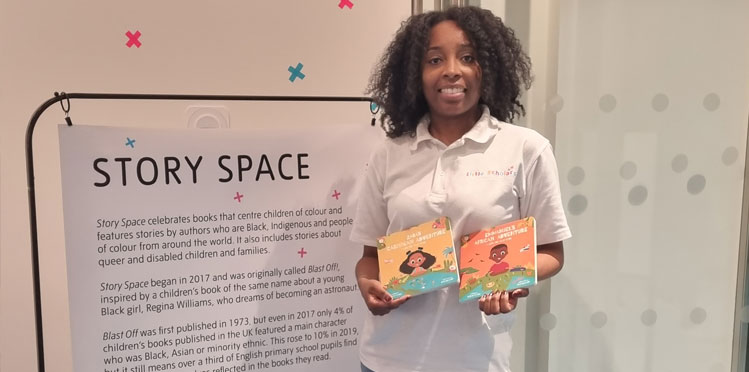
Stories are easy for children to remember, more than facts and numbers. That’s why repetition and regular reading to children is important. Reading diverse books to children is also important, as they can also help to change current attitudes and beliefs. Places like Story Space in Tate Britain are great. Story Space is a workshop for families of all ages to come together, imagine, and explore the world of storytelling at the Tate Britain. You can discover a library of books by Black authors, Indigenous authors and authors of colour from around the world.
We recently did a Storytelling of two of our books. Zara’s Caribbean Adventure and Emmanuel’s African Adventure. It was lots of fun connecting with both parents and children. In Zara’s Caribbean Adventure she attends Carnival, so I brought one of my headpieces and in Emmanuel’s African Adventure, Grandmama goes to the market, so I brought out a basket and got the kids to name the fruit and veg common in Africa. It was a great way to expose the children to the African and Caribbean culture.
Natalie is the co-founder and illustrator at Little Scholars Playground. She is passionate about literacy, learning, illustrating, black women in STEM and Montessori.